Cartographica Neerlandica Background for Ortelius Map No. 211
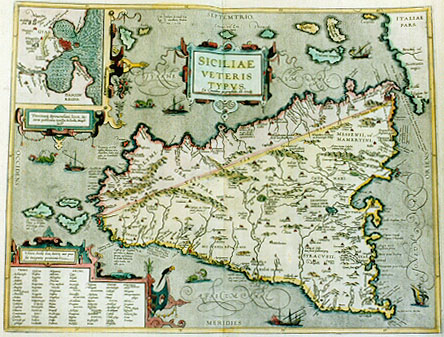
Title: SICILIAE | VETERIS | TYPVS. | "Ex conatibus geographicis A. Ortelij." [Map of Ancient Sicily from the geographical efforts of Abraham Ortelius]. (Top left centre:) "Cum priuilegio decennali Imp. | Reg. & cancellariæ Braban:|tiæ 1584". [With an Imperial, Royal and Council of Brabant Privilege for ten years. 1584.] (Bottom left corner:) "Veteris Siciliæ loca, incertæ aut pror:|sus incognitæ positionis" [Places on Ancient Sicily of uncertain or formerly unknown location], followed by a 7-column list). (Inset: 110 x 100 mm:) "Territorij Syrcusani loca, in:|certæ positionis: Acrillæ, Echetla, Magel:|la". [Places in the Syracuse area or uncertain location, viz. Acrillæ, Echetla and Magella] (Mid right:) "Erij montes, vel | Eræi, fertilitatis | admirandæ". [The Erij or Eræi mountains, admirable for their fertility]. (Mid right:) "Pergus lacus, | et vmbilicus | Siciliæ Hic | Proserpinam à Plutone | captam fe:|runt". [Lake Pergus, also the navel of Sicily. Here Proserpina was captured by Pluto]. (Midright:) "Aetna mons, Cælestis | columna Pindaro". [Mount Aetna, pillar of heaven, according to Pindarus]. (Textblock above the three islands west of Sicily, removed between 1592 and 1595 saying;) "Locaricum, et ad | oliuam urbes, ha:|bet Anton. inter | Hijccaram et Li:|lijbæum". [Locaricum, and the cities near the olive trees between Hijccara and Lilijbæum, according to Antoninus]. (More textblocks under Topographical names).
Plate size: 369 x 486 mm.
Scale: 1 : 825,000. Inset: 1 : 160,000.
Identification number: Ort 211 (Koeman/Meurer: 10P, Karrow: 1/157, van der Krogt AN: 7510H:31).
Occurrence in Theatrum editions and page number:
1584L3Addblank (100 copies printed) (identical to 1584L, but here without page number; last line, left aligned: cupiens vitare Charybdin; quæ vide apud Erasmum.),
1584G3Add13 in upper right corner (75 copies printed) (last line, left aligned, partly in Gothic script: "indicit in Scyllam cupiens vitare Charybdim", von welchem du lesen magst in Adagijs "Erasmi Roterodami".),
1585F3Add (75 copies printed) (last line, full width: aupres de l'Isle vers l'Orient, s'appele aussi la mer Ausoniêne: &dit qu'elle est fort profonde.),
1584L106 (750 copies printed) (identical to 1584L3Add, but here with page number; last line, left aligned: cupiens vitare Charybdin; quæ vide apud Erasmum.),
1587F104 (250 copies printed) (last line, left aligned: vers l'Orient,s'appelle aussi la mer Ausonienne: & dit qu'elle est fort profonde.),
1592L12 (525 copies printed) (last line, left aligned: piens vitare Charybdin.quæ vide apud Erasmum.),
1595LP (500 copies printed) (last line, left aligned: piens vitare Charybdum.quæ vide apud Erasmum.),
1601Lxxiij (200 copies printed) (last line, left aligned: vitare Charybdim.quæ vide apud Erasmum.),
1602G21 (250 copies printed) (last line, left aligned, partly in Gothic script: Incidit in Scyllam cupiens vitare Charybdim,won welchen du lesen magst in Adagijs Erasmi Roterdami.),
1603Lxxv (300 copies printed) (text and page number, but not typesetting, identical to 1609/1612S/L; 4th line from the bottom ends: Cal (also a variant with Ca-); last line, left aligned: vitate Charybdim. quæ vide apud Erasmum.),
1606Exxiij (300 copies printed) (last line, left aligned, in cursive script: "Chiliades"),
1608/1612Ixxv (300 copies printed) (last line, full width, in cursive script like the bottom half of the text: "antro in Scilla, desiderando di guardar si da Cariddi: le quali notitie vedi in Erasmo, doue raccoglie li prouerbij con libro grande".),
1609/1612Sxxv (text in Latin), = 1609/1612Lxxv (600 copies printed) (text and page number, but not typesetting, identical to 1603L; 4th line from the bottom ends: Capi- ; last line, left aligned: vitate Charybdim. quæ vide apud Erasmum.),
1617/1619BertiusDDD (200 copies printed) (text the same as Theatrum 1609/1612 but reset. Last line, left aligned: cupiens vitare Charybdim. quæ vide apud Erasmum.),
1624ParergonL/1641Sxxix (1025 copies printed) (last line second column first text page, right aligned: rabili- ; last line second column second text page, left aligned: smum.).
States: 211.1 as described.
211.2: between 1584 and 1587 "Cyane fons" was added in lower right corner, E3.
211.3: between 1587 and 1592 "Alba flu." was added in low centre, C3.
211.4: between 1592 and 1595, the text block above the three islands west of Sicily saying "Locaricum, et ad | oliuam vrbes, ha:|bet Anton. inter | Hijccaram et Li:|lijbaeum" [Locaricum and the cities near the olive trees according to Antoninus situated between the isles of Hijccara and Lilijbaeus] was removed and replaced by irregular dots, whereas the surrounding dots in the sea have a regular vertical pattern; "Eryx mons, Ad Olivam" & "Locaricum" were added middle left, B2; "Pirina, Comitianæ" & "Picinianæ" were added in centre C2.
211.5: after 1595L and before 1601, the sea under descriptions is no longer clear, but stippling has been added; "Engynum | Ptol." was added in lower right, D3; the first ornamental curve to the right of the cartouche with place names of uncertain location which used to be blank is now stippled, B3.
211.6: R.W. Bremner (personal communication) notes that in 1624LParergon "philippi" in the extreme left bottom corner has been changed to "Philippi".
Approximate number of copies printed: 5450.
Cartographic sources: made by Ortelius, based on Gastaldi's 1545 map of Sicily (Meurer p. 96, Karrow p. 218), supplemented by classical sources, viz. Plinius, Strabo, Dionysus and Hesiodus.
For questions/comments concerning this page, please e-mail info@orteliusmaps.com.